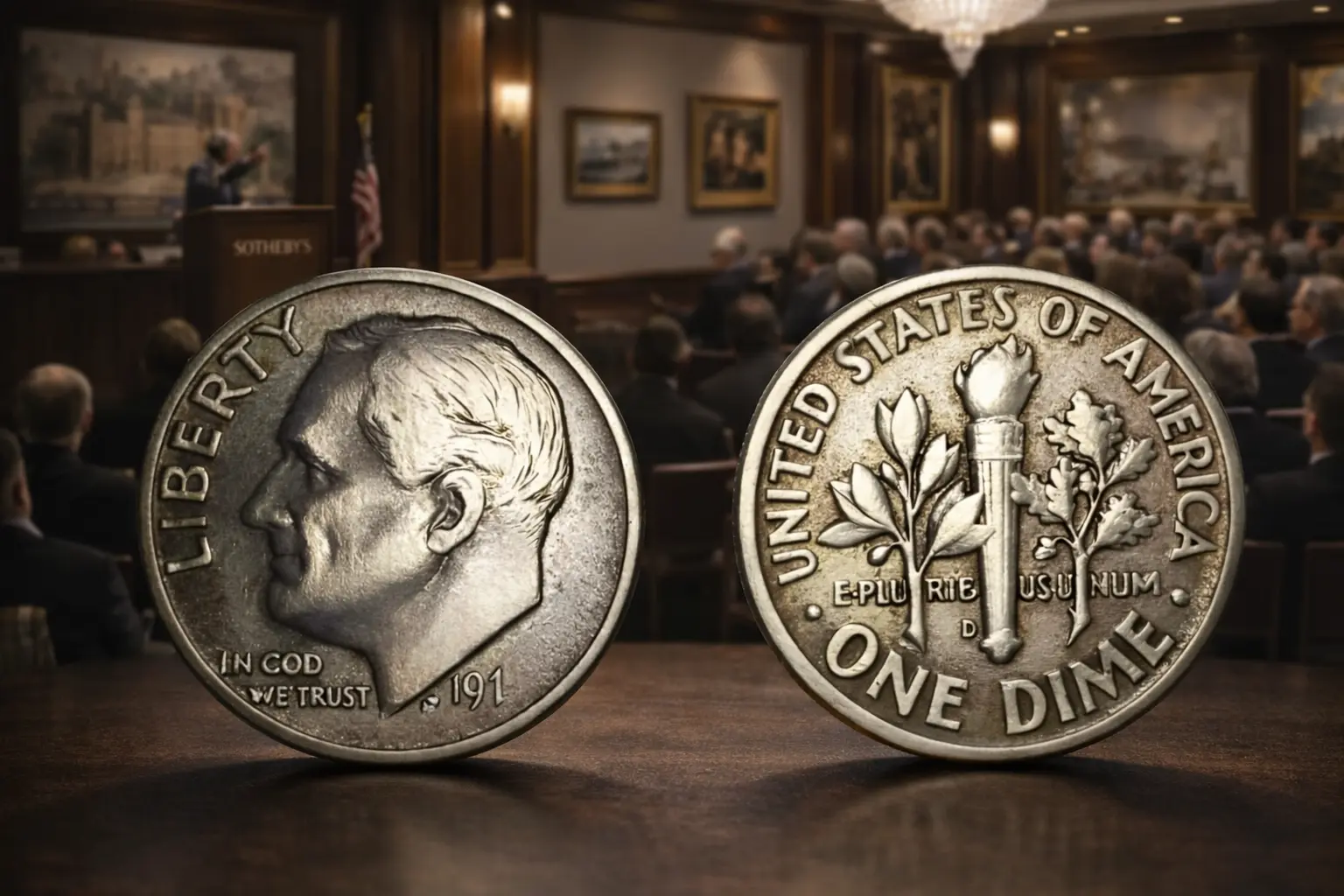
Since debuting in 1946, the Roosevelt dime has been a fixture of U.S. pocket change. Created to honor Franklin D. Roosevelt shortly after his death, the coin pairs a dignified portrait—modeled by John R. Sinnock—with a reverse symbolizing liberty, peace, and strength. Most examples are modest in value, yet a select group of low-mintage issues, missing mint marks, and dramatic mint errors has elevated certain Roosevelt dimes into true numismatic prizes.
In 2026, collectors still talk about an ultra-rare Roosevelt dime reportedly valued at $15.8 million—a near-mythic benchmark that captures the imagination of the hobby.
How the Roosevelt dime came to replace the Mercury dime
The Roosevelt dime succeeded the Mercury (Winged Liberty) dime in 1946. Its introduction was both a memorial to Roosevelt’s leadership through the Depression and World War II and a nod to his association with the March of Dimes polio campaign. Early issues (1946–1964) were struck in 90% silver; rising bullion prices prompted a switch to copper-nickel clad beginning in 1965.
What turns a common dime into a valuable one?
Most Roosevelt dimes circulate by the millions, but premiums rise sharply when one or more of these factors apply:
- Scarcity from low mintages or limited proof runs
- Mint errors (missing mint marks, doubled dies, off-center strikes)
- Special proof issues with pristine surfaces
- Condition, especially high mint-state or proof grades
- Collector demand for iconic varieties and anomalies
The $15.8 million Roosevelt dime—legend explained
Among all Roosevelt dimes, one coin is often cited at $15.8 million. Accounts describe a unique error strike—possibly produced under unusual mint conditions—and preserved in exceptional state. While details are closely guarded and public confirmation is scarce, the story endures because it combines singularity, mystery, and top-tier preservation. Whether viewed as a confirmed sale or a benchmark legend, it represents the ceiling of what collectors dream a dime could be.
Roosevelt dimes collectors pursue
Certain dates and varieties consistently stand out:
- 1949-S – low mintage; scarce in high grades
- 1950-S – another low mintage with strong demand
- 1968 No S Proof – missing San Francisco mint mark
- 1970 No S Proof – even rarer missing mint mark
- 1982 No P – Philadelphia issue without the “P”
- High-grade silver issues (1946–1964) – value climbs rapidly in MS condition
Error coins: small mistakes, big premiums
Errors add excitement—and value—to Roosevelt dimes:
- Doubled dies (front or back)
- Off-center strikes with visible date
- Wrong planchet strikes
- Missing mint marks, especially in proofs
Depending on visibility and grade, these can lift values from a few dollars to the thousands.
2026 value snapshot (general guide)
| Year / Variety | Metal | Circulated | Mint State / Proof | Why It Matters |
|---|---|---|---|---|
| 1949-S | 90% Silver | $5–$15 | $200+ | Low mintage |
| 1950-S | 90% Silver | $5–$20 | $250+ | Scarce issue |
| 1968 No S Proof | Proof | — | $10,000+ | Missing mint mark |
| 1970 No S Proof | Proof | — | $15,000+ | Extremely rare |
| 1982 No P | Clad | $50–$100 | $500+ | Modern rarity |
| Common clad | Clad | Face value | $5–$20 | Value in high grade |
Actual prices vary by condition and demand.
What collectors are watching in 2026
- Renewed interest in pre-1965 silver
- Strong bids for No S and No P errors
- Premiums for coins certified by Professional Coin Grading Service (PCGS) and Numismatic Guaranty Company (NGC)
- Set builders chasing complete runs
- Online auctions intensifying competition
Grading basics: why condition is king
Roosevelt dimes are graded from P-1 to MS-70. Value hinges on:
- Strike sharpness
- Original luster
- Surface preservation
- Overall eye appeal
Professional certification confirms authenticity and often unlocks higher market confidence.
Practical tips for collectors
- Inspect under strong light and magnification
- Weigh and edge-check silver pieces
- Store in inert holders to prevent damage
- Grade scarce dates and suspected errors
- Monitor auction results to gauge real prices
Inherited rolls and jars still yield surprises.
Why Roosevelt dimes endure
Beyond dollar signs, Roosevelt dimes tell a story of postwar America—honoring a pivotal president while remaining practical for daily use. The blend of history, attainable collecting goals, and the tantalizing possibility of a once-in-a-generation discovery keeps interest alive.
Bottom line: most Roosevelt dimes are ordinary, but the right date, error, and grade can turn a small coin into a standout collectible—sometimes, at least in legend, worth millions.